

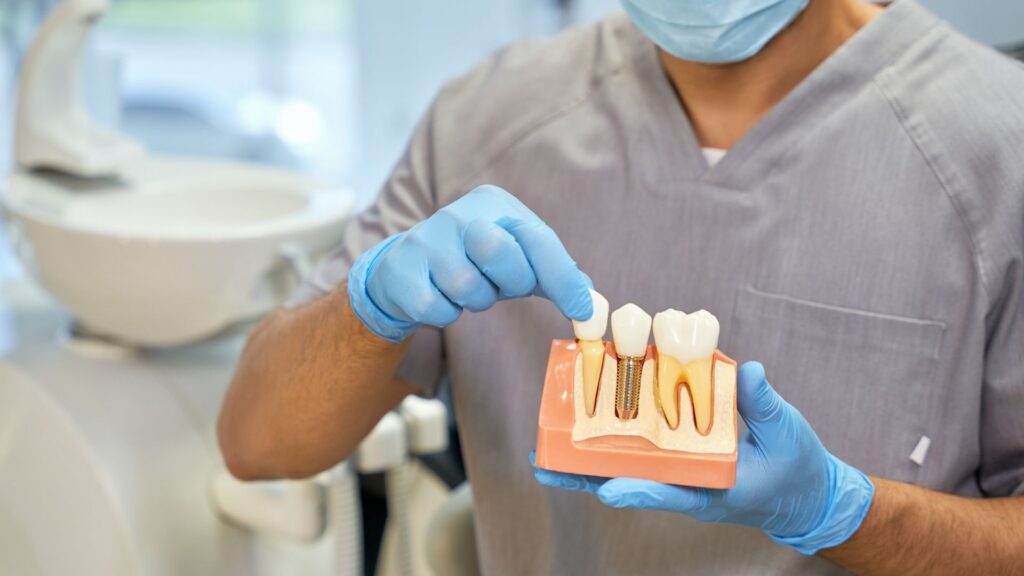
Dental implants are among the most successful replacements for missing teeth. According to pooled analyses of long-term follow-up studies, 95–98% of implants function for ten years or more without complications. This also means that 2–5% of implants fail. Knowing the main causes allows you to actively prevent most of them.
This article summarises what puts an implant at risk and how m2stoma Brno works to prevent failure.
The main causes of implant failure
Implant failure can be divided according to the time at which it occurs:
- Peri-implantitis. A bacterial inflammation of the tissues around an implant that progresses from mucositis, inflammation limited to the gum, to bone destruction. Without treatment, it can lead to implant loss.
- Smoking. Smoking reduces blood supply to the tissues and slows healing. The risk of failure in smokers is approximately twice that of non-smokers.
- Uncontrolled diabetes. High blood glucose impairs healing and weakens the immune response. A patient with well-controlled diabetes has a prognosis comparable to that of a person without diabetes.
- A history of periodontitis. Anyone who has had periodontitis in the past has a higher risk of peri-implantitis and implant failure.
- Biomechanical overload. Bruxism, or teeth grinding, poorly designed prosthetics or excessive pressure at a single point can cause loss of osseointegration over time.
- Insufficient long-term care. An implant needs the same attention as a natural tooth. Missing professional hygiene appointments and regular check-ups significantly increases the risk of peri-implantitis.
How peri-implantitis develops
Peri-implantitis does not appear out of nowhere. It begins as mucositis, an inflammation of the gum around the implant caused by bacterial biofilm. If mucositis is not treated, the inflammation spreads deeper and begins to destroy bone. At that point, it is called peri-implantitis.
Watch for gum bleeding around the implant during brushing, sensitivity, swelling, gum recession, pus or an unpleasant odour. In advanced cases, the implant itself may become loose.
When mucositis is detected early, it can almost always be managed with professional hygiene and home care. Late detection of advanced peri-implantitis with bone loss often leads to implant loss.
How m2stoma prevents implant failure
In m2stoma, we have developed a protocol over fifteen years of practice that actively prevents implant failure:
- CBCT planning before every implant placement. A 3D scan shows the height and density of the bone as well as important anatomical structures. Modern implantology cannot be carried out safely without it.
- An individual recall plan. We set check-ups for patients with implants according to their risk profile, typically every 3–6 months. There is no universal “twice a year” rule.
- The GBT protocol and Airflow with erythritol. This advanced hygiene treatment cleans around the implant without damaging its surface. Erythritol particles, 14 μm in size, are a gentle but effective natural powder.
- Early detection of problems. At every check-up, the dental hygienist and dentist assess the gum around the implant and measure the sulcus depth, the pocket between the implant and the gum. Early mucositis is treated straight away.
What can you do at home?
Your habits matter a great deal. We explain home care in more detail in the article Caring for Dental Implants.
- Use a soft toothbrush and a gentle technique twice a day.
- Use interdental brushes or an oral irrigator around the implant.
- If you smoke, try to reduce or stop. The risk begins to fall from the first day.
- Attend regular check-ups according to your recommended recall plan.
- If you have controlled diabetes, monitor your blood glucose level.
Frequently Asked Questions
How can I recognise peri-implantitis?
Gum bleeding during brushing, swelling, gum recession and sensitivity are warning signs. In advanced stages, pus or a loose implant may appear. Contact your dentist if you notice any of these symptoms.
What percentage of implants fail?
According to pooled analyses, 95–98% of implants are still functioning after ten years. Failure is therefore the exception rather than the rule, but it cannot be ruled out completely.
What should I do if my implant feels loose?
Book an urgent appointment with your dentist. A loose implant indicates loss of osseointegration and requires prompt surgical treatment. Delaying treatment reduces the chance of preserving enough bone for future reimplantation.
Conclusion
Implant failure has well-described causes, and almost all of them can be prevented or managed. The key is a combination of high-quality surgery, an individual recall plan and consistent home care. At m2stoma Brno, we set check-ups for patients with implants individually according to their risk profile. Book an initial consultation to receive a care plan tailored to you.