

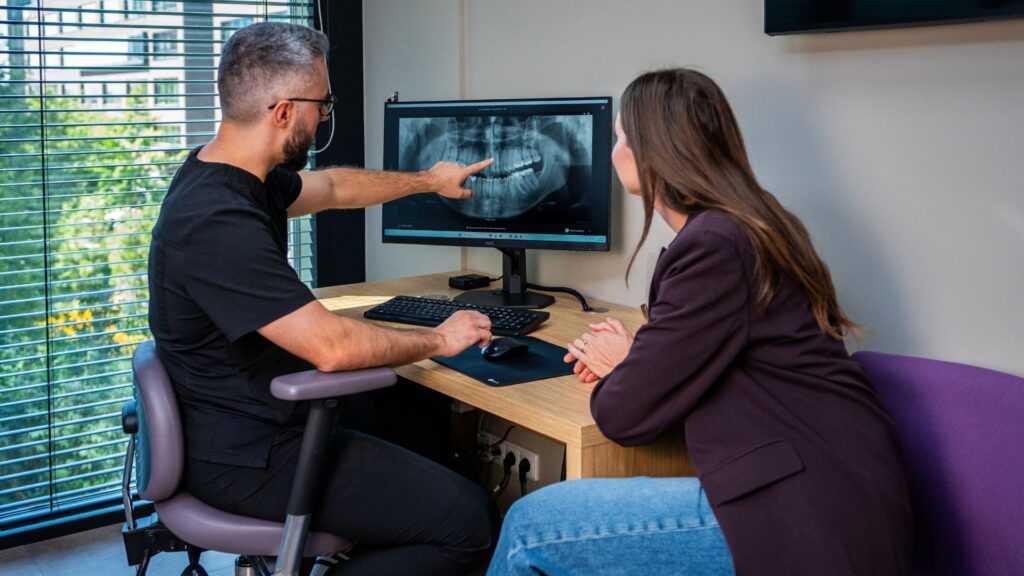
A root perforation is an unwanted opening in the wall of a tooth. It may occur during root canal treatment or post placement, or without a previous procedure because of deep decay or resorption. It may be detected immediately or at a later check-up.
A perforation does not necessarily mean losing the tooth. The prognosis depends primarily on the opening’s location and size, how quickly it is sealed and the surrounding bone. A 3D scan can help assess it.
What is a perforation and how does it occur?
A perforation is an opening in the tooth or root wall connecting its interior with the surrounding tissues.
It can develop in several ways:
- while locating the entrance to a root canal, particularly when the canal is calcified or positioned unusually
- while placing a post inside the root after root canal treatment
- while preparing a severely curved canal, if the instrument deviates from its natural course
- because of root resorption, meaning the gradual breakdown of root tissue, or deep decay extending below the gum line, without any previous procedure
Bacteria can enter and cause inflammation and bone loss. Damage depends partly on the opening’s size and how long it remains unsealed.
What determines whether the tooth can be saved?
Several factors affect the prognosis:
- Location. An opening near the root tip, away from the gum, has a better prognosis than one at the gum margin or tooth neck.
- Time before sealing. Immediate or prompt sealing is better than leaving it open for weeks or months.
- Size. A small opening has a better prognosis than a large defect.
- Bone condition. Preserved bone is more favourable than existing bone loss.
Location is particularly important. An opening near the gum is harder to isolate from oral bacteria. One deeper within the bone can usually be sealed more effectively so the tissues can heal.
The sooner it is sealed, the lower the risk of inflammation and bone loss.
How is a perforation treated?
Treatment depends on the opening’s location and extent. The dentist first identifies it and assesses the surrounding tissues.
- Diagnosis. A 3D scan can show the opening’s location and size and the surrounding bone.
- Microscope-assisted access. Magnification helps locate it and allows safe work in a small space.
- Cleaning the area. Inflamed tissue and any remnants of foreign material are removed.
- Sealing. A material suitable for a moist environment closes the opening and supports tissue healing.
- Completing root canal treatment. The dentist then completes the original treatment of the tooth.
- Follow-up X-rays. Images show how the tissues heal.
We explain why adequate magnification matters in these procedures in our article about treatment under a dental microscope. Treating a perforation forms part of endodontics, although an opening near the neck of the tooth may also require a surgical approach.
When can the tooth not be saved?
Saving the tooth is more difficult in particular when:
- the perforation is large and located near the neck of the tooth, where it is continually exposed to bacteria from the mouth
- a substantial amount of bone has been lost and the tooth no longer has adequate support
- the root is also cracked or the perforation is associated with a fracture
- the tooth could not be restored to function even after the opening had been sealed
The dentist will then discuss extraction and replacement. The decision should reflect the tooth and bone, not another attempt at all costs.
Frequently asked questions
What is a root perforation?
A perforation is an opening in the wall of a tooth or root that connects the inside of the tooth with the surrounding tissues. It may occur during root canal treatment or post placement, but it can also be caused by deep decay or resorption.
Can a tooth with a perforation be saved?
Often, yes. Smaller perforations that are sealed promptly and have not caused significant damage to the surrounding tissues have a better prognosis. Large openings near the gum margin and perforations associated with substantial bone loss have a less favourable outlook.
Does a root perforation hurt?
A perforation may not hurt at all, especially if the tooth has already undergone root canal treatment. It may cause pressure or inflammation of the gum at the site of the opening, or the dentist may only discover it on an X-ray.
How does a perforation occur?
It may develop during treatment of a tooth with complex anatomy, or it may be caused by deep decay or resorption. The location and size of the opening, the time before it is sealed and the condition of the surrounding tissues are the key factors when deciding what to do next.
Conclusion
A perforation does not automatically mean that you will lose the tooth. Whether it can be saved depends primarily on the location and size of the opening, how quickly it is treated and the condition of the surrounding tissues. A small perforation sealed promptly generally has a better prognosis than a large defect near the gum associated with bone loss.
Do you have a perforated root and want to know whether the tooth can be saved? Book a consultation at m2stoma in Brno to discuss the next step. A 3D scan can help the dentist assess the tooth and surrounding tissues and talk you through the available options.
Meta descriptions
CZ: Perforace kořene nemusí znamenat ztrátu zubu. Zjistěte, co rozhoduje o jeho záchraně, jak probíhá uzavření otvoru a kdy už léčba nedává smysl.
EN: A root perforation does not always mean losing the tooth. Learn what affects the prognosis, how the opening is sealed and when treatment may no longer help.