

One in ten Czech adults has lost at least one tooth. If you are among them, you know how much it affects not only your ability to chew but also your confidence when smiling. Dental implants offer a solution that comes closest to a natural tooth — with scientifically proven success rates exceeding 90 % even after two decades.
In this guide, you will learn everything that matters: how the implant procedure works, how long healing takes, whether it hurts and who is a suitable candidate. All backed by current studies and experience from our practice.
What Is a Dental Implant?
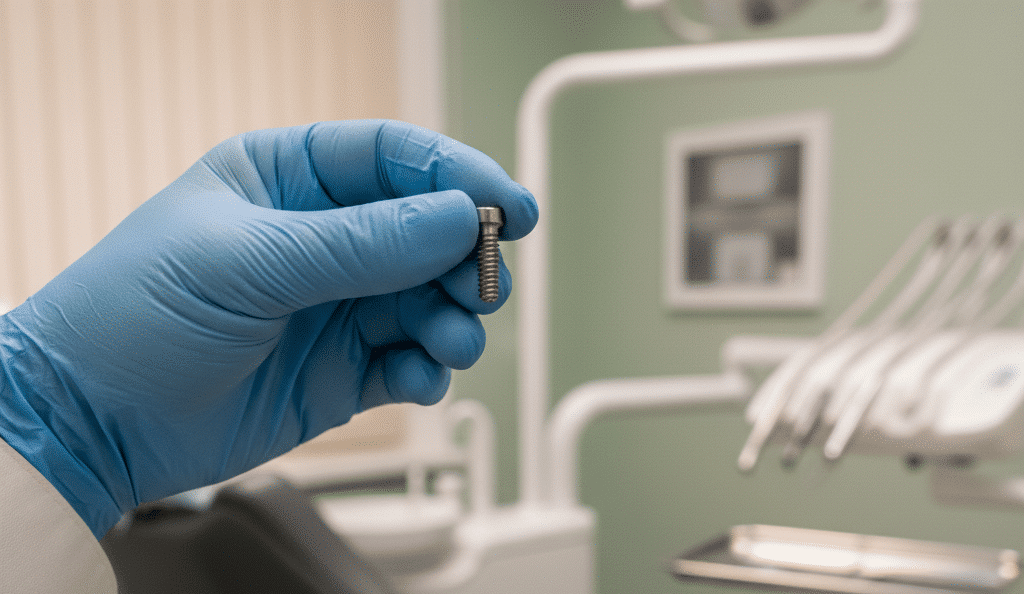
A dental implant is a titanium screw that is surgically placed into the jawbone, replacing the root of a missing tooth. Unlike a dental bridge or a removable denture, it functions independently and does not affect the surrounding healthy teeth.
It consists of three parts:
- Implant (screw) — placed into the jawbone to replace the tooth root. Titanium has over 60 years of proven biocompatibility.
- Abutment (connector) — a connecting element between the implant and the crown, protruding above the gum line.
- Crown — a ceramic or zirconia tooth replacement that looks and functions like a natural tooth.
The key to success is osseointegration — a biological process in which bone gradually grows into the implant surface. It proceeds in several phases: from the formation of initial collagen fibres in the first days to mature lamellar bone after 12 weeks.
Types of Dental Implants
By Design
Bone level — the implant sits below the gum line, which closes over it. Natural healing with minimal infection risk.
Tissue level — the implant collar sits at gum level and a healing cap is placed immediately. This simplifies the prosthetic phase.
By Number of Teeth Replaced
Single implant — replaces one missing tooth. The most common solution.
Implant-supported bridge — 2–3 implants support a bridge replacing 3–5 teeth.
All-on-4 / All-on-6 — a full arch on 4–6 implants. The posterior implants are placed at an angle, making it possible to utilise bone with a smaller volume. The technique has proven biomechanical advantages confirmed in the literature.
Mini-implants — thinner implants used mainly to stabilise removable dentures.
How Does the Implant Procedure Work Step by Step?
The entire process from the initial consultation to the final crown typically takes 4–8 months.
1. Initial Consultation and Examination
The implantologist carries out a clinical examination and assesses the condition of the gums and bone using a panoramic X-ray or 3D CT scan (CBCT). Based on the findings, a treatment plan is proposed — number of implants, type of restoration, timeline and an estimated cost.
2. Preparatory Phase (If Needed)
Not every patient has enough bone for safe implant placement. In such cases, additional procedures may be required:
Bone augmentation — supplementing bone tissue with synthetic material or the patient’s own bone. Healing time: 3–6 months.
Sinus lift — elevating the floor of the maxillary sinus in the upper jaw. This makes it possible to place an implant of sufficient length.
3. Implant Placement
The surgical procedure itself takes 30–60 minutes per implant. It is performed under local anaesthesia — you feel no pain during the procedure, only pressure. The titanium screw is inserted into a pre-prepared site in the bone.
4. Healing (Osseointegration)
The most important phase, during which bone grows into the implant surface:
- Lower jaw: 3–4 months (harder bone)
- Upper jaw: 5–6 months (softer bone)
According to a study published in BioMed Research International (2022), secondary stability (biological bone integration) is crucial for the long-term success of the implant.
5. Crown Placement
Once healing is complete, the implant is uncovered, the abutment is attached and a dental technician fabricates a custom crown. After placement, the implant is fully functional.
Would you like to know how the implant procedure would work in your case? Book a consultation — after an examination, we will propose an exact treatment plan including a timeline.
Does Getting a Dental Implant Hurt?
This is one of the most common questions we hear from patients.
During the procedure you feel no pain — implant placement is carried out under local anaesthesia, comparable to a routine dental treatment. You only feel pressure and vibration. For patients with greater anxiety, we offer sedation.
After the procedure (first 2–3 days) you may experience mild swelling and discomfort, manageable with standard analgesics (ibuprofen). Most patients describe the sensation as “a slightly worse day after a tooth extraction.”
In the long term, the implant has no nerves — it cannot cause pain by itself. If you feel pain around the implant after healing, visit your dentist.
Caring for Dental Implants
First 14 Days After the Procedure
- Soft diet (yoghurt, soups, purées)
- Chlorhexidine rinses twice daily from the second day
- No smoking, alcohol, strenuous exercise or sauna visits
- Warning signs (contact your implantologist): persistent pain or swelling after 7 days, fever, implant loosening.
Long-Term Care
An implant cannot develop a cavity, but the tissues around it can develop peri-implantitis — an inflammatory condition that, according to a meta-analysis in Journal of Dentistry (2017), affects 19.83 % of patients with implants.
Prevention is straightforward:
- Brush twice daily + use interdental brushes
- Dental check-up every 6 months
- Professional dental cleaning twice a year
- Do not smoke
With proper care, an implant lasts 20–30 years or longer. A meta-analysis in Clinical Oral Investigations (2024) reports a 10-year survival rate of 92 % and a 20-year survival rate of 88 %.
Who Is a Suitable Candidate for Implants (and Who Is Not)?
Ideal Candidates
- Loss of one or more teeth
- Sufficient bone volume (or willingness to undergo augmentation)
- Good overall health and oral hygiene
- Non-smokers (smoking increases the risk of failure 2–3×)
When Implant Placement Is Not Possible
- Uncontrolled severe osteoporosis (bisphosphonate therapy)
- Active oncological treatment (radiotherapy of the head and neck)
- Uncontrolled diabetes (HbA1c > 8 %)
- Incomplete jaw growth (under 18 years of age)
Not sure whether you qualify? Come in for an examination — after an X-ray, we will tell you whether implants are a viable option in your case.
How Much Do Dental Implants Cost?
The price depends on the individual situation — the number of implants, the need for bone augmentation, the type of prosthetic restoration and other factors. That is why we prepare a detailed cost plan for each patient only after a consultation and examination.
You can find our current price list here. We will be happy to prepare a detailed cost estimate for your specific case at the consultation.
Health insurance in the Czech Republic does not normally cover dental implants. Exceptions include implant placement following oncological treatment, trauma or congenital jaw defects.
Frequently Asked Questions
How long does the entire implant process take?
The whole process from implant placement to the final crown takes 4–8 months. The surgical procedure itself takes 30–60 minutes per implant. If bone augmentation is needed, the process is extended by an additional 3–6 months.
Is it possible to place an implant immediately after extraction?
Yes, so-called immediate implantation is possible provided the bone is in good condition and there is no infection present. The advantage is a shorter overall treatment time and preservation of bone volume. The decision depends on the implantologist’s assessment at the time of extraction.
What is peri-implantitis and how can it be prevented?
Peri-implantitis is an inflammation of the tissues around the implant, similar to periodontitis. It manifests as gum bleeding and bone loss. Prevention involves thorough hygiene, regular check-ups every 6 months and not smoking.
Can I have an implant if I smoke?
Yes, but smoking increases the risk of failure 2–3×. We recommend not smoking for at least 2 weeks before the procedure and 8 weeks afterwards. If you cannot quit, inform your implantologist — the treatment protocol can be adjusted.
Does health insurance cover dental implants?
Not as standard. Exceptions: implant placement following oncological treatment, trauma or congenital jaw defects. You can deduct the costs from your taxes as healthcare expenses.
Conclusion
Dental implants are the most reliable method of replacing lost teeth. Scientific studies confirm a success rate of 88–92 % even after 20 years. They do not affect healthy teeth, prevent bone loss and, with proper care, last for decades.
Ready to take the first step? Book a consultation — after an examination and a 3D CT scan, we will propose an exact treatment plan including the cost.