

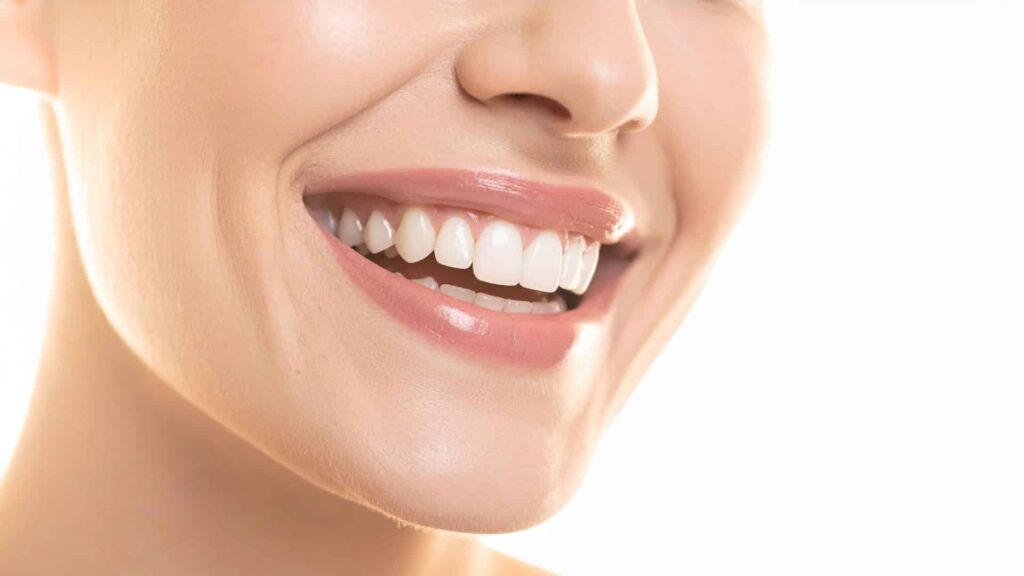
Teeth whitening is becoming increasingly common across all age groups. No wonder — up to 70% of patients report a noticeable improvement in self-confidence and quality of life after an aesthetic dental procedure.
The most common question patients ask, however, isn’t “how much does it cost?” It’s: “Does it actually work, or is it just marketing? Will it damage my enamel? Is the result worth the money?”
This complete guide provides answers based on clinical studies, compares the methods available in Brno, sets realistic expectations for the outcome, and explains when whitening doesn’t make sense — and shouldn’t be performed at all.
What Teeth Whitening Actually Does (and Doesn’t)
Teeth whitening is an aesthetic procedure in which peroxide gels (hydrogen peroxide 25–40% or carbamide peroxide 10–22%) oxidise pigments trapped in the enamel and dentin. The process lightens teeth by 2 to 8 shades on the clinical VITA scale, and the result lasts 1 to 3 years depending on lifestyle. Professional whitening is an effective and safe aesthetic procedure when performed according to the protocol of a certified product.
What whitening can do:
- Lighten teeth darkened by coffee, black tea, red wine and smoking.
- Reduce yellow or brownish discolouration caused by ageing of the enamel.
- Provide a short-term aesthetic improvement before important events.
What whitening cannot do:
- Lighten artificial materials — fillings, crowns and veneers remain in their original shade.
- Resolve tooth decay or gum inflammation (these must be treated before whitening).
- Lighten teeth darkened from an internal cause (e.g. after root canal treatment) — these require intracoronal bleaching, a different protocol.
If you have large fillings or crowns, the result will be uneven — the surrounding teeth will lighten, but the fillings or crowns will remain in the original colour. In that case, the fillings should be replaced with a matching shade after whitening, or an alternative such as veneers should be considered.
4 Methods of Teeth Whitening in Brno 2026
Patients in Brno can choose from four main approaches. The first is at-home whitening with a custom tray, which takes 2–3 weeks, delivers 4–6 shades of lightening, and is well suited to anyone seeking a lasting and more economical option. The second is professional in-office whitening, completed in a single 60–90 minute session and achieving 6–8 shades of lightening — ideal for a quick result before a major event. The third option is the combined protocol of in-office plus at-home whitening, consisting of one in-office session followed by about a week of home application, which produces the strongest result (8–10 shades) and the longest durability. The fourth category — beauty salon treatments and over-the-counter strips — offers only very limited results (1–2 shades), is unregulated for professional use, and may damage the enamel.
The sections below look at each method in detail — how it works, who it suits, and how the methods differ.
At-Home Whitening with a Custom Tray
At-home whitening doesn’t mean over-the-counter strips from a pharmacy. It is a professional protocol built on two pillars: a tray custom-made to fit your teeth exactly, and a bleaching gel containing 10–16% carbamide peroxide that must be prescribed by a dentist.
How it works:
- Initial examination and professional dental hygiene.
- Digital scan (intraoral scanner) or impression.
- Laboratory production of the custom tray (around 14 days).
- Handover of the tray and a set of gels with instructions.
- Application at home — gel into the tray, tray onto the teeth, 4–8 hours daily for 2–3 weeks.
- Follow-up appointment after completion.
Advantages:
- Cost-effective.
- Gentle on the teeth — a lower peroxide concentration means a lower risk of sensitivity.
- The same tray can be reused for top-up whitening once a year.
- Long-lasting result.
Disadvantages:
- Requires discipline — skipping three days in a week will produce a limited result.
- Slower — visible effect only after 7–10 days.
Professional In-Office Whitening
In-office whitening is the fastest route to a white smile — typically one session, with a visible result the same day.
How it works:
- Professional dental hygiene 1–2 weeks beforehand.
- On the day of whitening: protection of the gums with a barrier gel and retraction of the lips with a retractor.
- Application of the bleaching gel (hydrogen peroxide 25–40%).
- Activation with an LED lamp, or no activation depending on the product.
- 3–4 cycles of 15 minutes each, with the gel refreshed between cycles.
- Fluoride application at the end.
The whole session takes 60–90 minutes.
Advantages:
- A quick result visible in a single session.
- Higher potency — 6–8 shades of lightening.
- The dentist supervises throughout the procedure.
Disadvantages:
- More expensive.
- Without a follow-up at-home protocol, the effect may fade more quickly.
Combined Protocol – Maximum Effect
For patients who want the strongest lightening and the longest durability, a combination of in-office and at-home whitening is the best option.
The process:
- Professional hygiene.
- One in-office session.
- A custom at-home tray.
- 7–10 days of at-home whitening — to fix the result and add another 2 shades.
Whitening at a Beauty Salon vs. a Dental Clinic
Whitening offered in beauty salons and cosmetic studios has been spreading recently. There are several things worth knowing.
Under EU Cosmetics Regulation 1223/2009, which also applies in the Czech Republic, only hydrogen peroxide of up to 0.1% is permitted for non-professional use. Professional whitening may only be carried out by a dentist — not a beautician.
A beauty salon claiming to whiten “the same as a dentist” is either using unauthorised concentrations, or its effect is extremely limited.
Without an initial examination, there is a risk of complications in patients with untreated tooth decay or periodontitis.
Over-the-counter strips from a pharmacy have limited efficacy — typically 1–2 shades of lightening after several weeks of daily use.
Sensitivity After Whitening and How to Manage It
Sensitivity is the most common side effect of whitening. 60–80% of patients report sensitivity to cold or sweet stimuli after professional whitening, which typically lasts 24 to 48 hours.
Prevention:
- Use a toothpaste for sensitive teeth (with potassium nitrate or arginine) for 1–2 weeks before whitening.
- Apply a fluoride gel (Sensodyne Pronamel, Elmex) the day before whitening.
- Avoid acidic drinks (juices, cola, sparkling water) for 24 hours before and after.
Managing acute sensitivity:
- Sensitive-teeth toothpaste twice daily for one week.
- No very cold or very hot drinks for 48 hours after the procedure.
- If sensitivity lasts more than 5 days, contact the clinic — a high-concentration fluoride gel will resolve it quickly.
When Teeth Whitening Cannot Be Performed
Whitening isn’t for everyone. Contraindications include:
- Active tooth decay — must be treated first. Peroxide would penetrate the pulp and cause pain.
- Unresolved periodontitis — peroxide can seep into exposed roots.
- Children under 16 — the enamel is still maturing, with a risk of damage.
- Pregnancy and breastfeeding — there’s a lack of long-term studies, so it’s recommended to postpone.
- Allergy to peroxide — rare, but it does occur. If you have a history of allergic reactions, inform your dentist.
- Large fillings, crowns or veneers on the front teeth — they will remain their original colour, producing an uneven result.
- A non-vital (dead) tooth — these are whitened with a different protocol from the inside (intracoronal bleaching).
An initial examination before whitening is therefore essential — it identifies potential problems and allows a realistic plan to be drawn up.
How Long the Result Lasts
The whitening result lasts 1 to 3 years. There are, however, several factors that shorten the effect:
- Coffee, black and green tea.
- Red wine.
- Dark fruit juices (pomegranate, blueberry).
- Soy sauce, balsamic vinegar.
- Smoking (dramatically shortens the effect).
- Chocolate and dark sweets.
What will prolong the result:
- A top-up gel at home once every 6–12 months.
- Professional dental hygiene twice a year.
- A toothpaste with peroxide or activated charcoal as maintenance.
- Drinking beverages through a straw for the first 14 days after whitening.
Teeth never return precisely to their original shade — the result will always be several tones lighter than before whitening.
Frequently Asked Questions
Does teeth whitening hurt?
The whitening itself doesn’t — the patient sits in the chair and feels only mild pressure from the retractor. After the procedure, 60–80% of patients experience temporary sensitivity to cold that subsides within 24–48 hours.
How many shades of lightening can I expect?
Realistically 4 to 8 shades on the VITA scale, depending on the method. The at-home tray delivers 4–6 shades, in-office whitening 6–8, and a combined protocol up to 10. If your teeth are darkened by tetracycline, the lightening is usually smaller and requires a special procedure.
Can I whiten my teeth while wearing braces?
With fixed braces, no — darker patches would remain under the brackets. With removable braces, yes — the bleaching gel is often applied directly into the aligners.
What if I have veneers or crowns on my front teeth?
Whitening doesn’t lighten artificial materials. If you want a uniform colour, your natural teeth need to be whitened to the target shade first, and then the veneers or crowns replaced with a matching shade.
Whitening vs. veneers — when to choose which?
Whitening only addresses colour. Veneers change the colour, shape, position and minor irregularities. If your teeth are the right shape and you simply want a lighter shade, choose whitening. If you also want to change the shape or correct minor irregularities, veneers are the better investment.
Is whitening safe?
Professional whitening carried out by a dentist according to the protocol of certified products is safe. The risk lies in OTC products with undocumented concentrations, or in beauty salons that don’t perform an initial examination.