

“They promised six shades whiter teeth in four weeks. After a month, I look at myself in the mirror and tell myself: nothing.” This is the experience reported by most users of OTC whitening strips from the chemist.
The path of at-home whitening is tempting. 800 CZK (approx. €33) for strips at the chemist looks like a reasonable alternative to 12,000 CZK (approx. €490) for whitening at the dental clinic. The reality is different: OTC products lighten teeth on average by 1 to 2 shades, professional whitening by 6 to 8. In between lies the golden middle path — at-home whitening with a custom tray from the dentist, which combines the price of a home protocol with the effectiveness of a professional approach.
In this article, you’ll find a comparison of all three categories and a decision framework for when to choose which method.
What Teeth Whitening Actually Does and Why Effectiveness Varies
Teeth whitening works on the principle of oxidising pigments stored in the enamel and dentine using peroxide gels. Effectiveness depends on the concentration of peroxide, which is legally capped at 0.1% in OTC products, while a dental professional can use 0.1–6%. This legal ceiling directly determines how many shades teeth will lighten: home strips 1–2, professional tray 4–6, in-office whitening 6–8.
Three Categories of Whitening and What to Expect from Them
OTC strips, gels and pastes from the chemist cost between 200 and 2,500 CZK (approx. €8–100). Their effectiveness is limited to 0–2 shades and safety is low — overall, they offer a very limited result.
An at-home tray prescribed by a dentist costs around 7,000–8,000 CZK (approx. €285–325). It delivers 4–6 shades of lightening with high safety. This is the golden middle path between price and effectiveness.
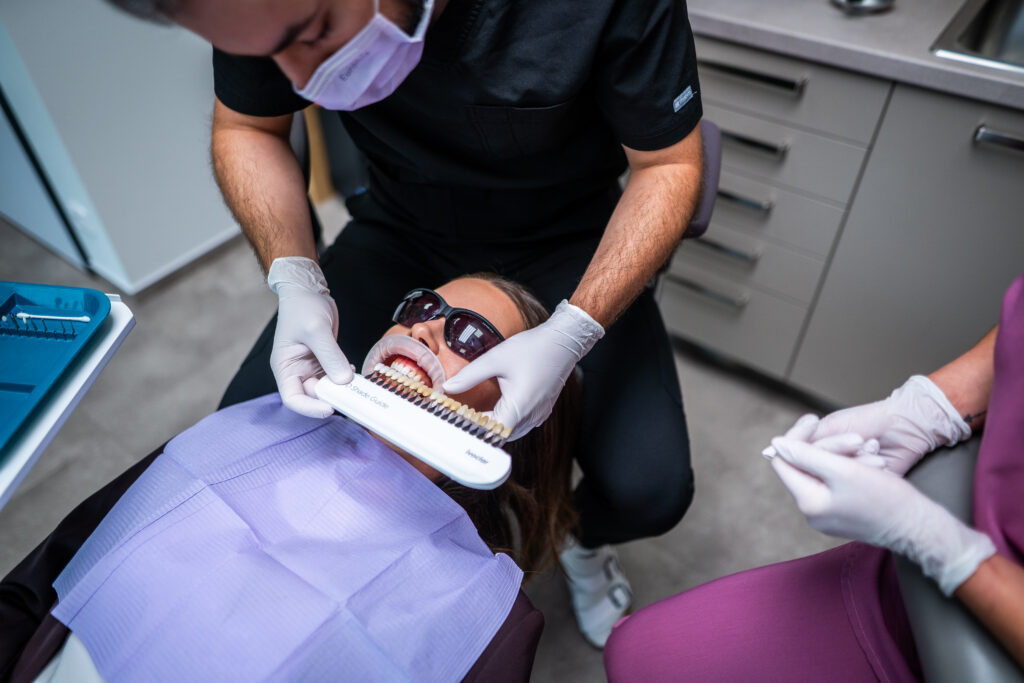
In-office whitening at the dental clinic costs around 12,000 CZK (approx. €490). It achieves 6–8 shades of lightening with very high safety — the fastest available option.
The crucial difference is not in price — it’s in the peroxide concentration permitted by law. EU Cosmetics Regulation 1223/2009 stipulates that consumer products may contain a maximum of 0.1% hydrogen peroxide. Professional products (0.1% to 6% hydrogen peroxide, equivalent to carbamide peroxide up to 16%) may be provided exclusively by a dentist. This regulation also applies in the Czech Republic.
This means that strips from the chemist legally cannot contain an effective amount of peroxide. Their effect is therefore biologically limited — even if their marketing says otherwise.
OTC Whitening Strips — Do They Work at All?
Whitening pastes, gels, powders, strips and other products feature dramatic “before and after” photos in their marketing. The clinical reality is more modest.
A meta-analysis published in Bioengineering (2024) states that OTC strips lighten teeth on average by 1 to 2 shades after 2–4 weeks of daily use — in contrast to professional protocols, which achieve 4 to 8 shades.
The main problems with OTC strips:
- Low peroxide concentration. To comply with EU regulations for consumer products, they contain a very low concentration of the active substance.
- Poor adhesion to teeth. Strips float on saliva and seat themselves imprecisely. Some parts of the teeth get whitened, others don’t.
- Uneven whitening of interdental spaces. Spaces between teeth remain darker.
- No initial examination. A patient with active decay or periodontitis uses strips without any check-up — with the risk of irritation and complications.
Whitening Toothpastes — Marketing or a Real Helper?
Toothpastes labelled “whitening” are among the best-selling products in the chemist. What do they actually do?
Peroxide-based pastes — peroxide under 0.1%, minimal whitening effect. Most of the effect comes from mildly abrasive ingredients that remove surface stains from coffee and smoking.
Activated charcoal pastes. A trend in recent years, but clinical evidence is lacking. A systematic review in JADA (2017) noted a lack of evidence for safety and effectiveness — on the contrary, high abrasiveness can wear down the enamel with long-term use.
PAP-based pastes (Phthalimido-Peroxy-Caproic Acid). A newer trend without peroxide, promising gentle whitening. Clinical data is still limited.
Hydroxyapatite-based pastes. They support remineralisation and have a mild cosmetic effect on surface stains.
Toothpastes make sense as a maintenance product after professional whitening, or as prevention of surface staining for patients who, for example, drink a lot of coffee. As a primary whitening method, they will not achieve a visible effect.
Professional At-Home Whitening with a Custom Tray
This is where the middle ground lies — the compromise. “At-home whitening” in this context does not mean OTC products from the chemist — it is a professional protocol that you carry out at home with materials prescribed by your dentist.
How it works:
- Professional dental hygiene appointment.
- Scan or impression of the teeth and fabrication of a custom tray in the laboratory.
- Hand-over of the tray and a set of gels with 10–16% carbamide peroxide.
- Application at home for 4–8 hours a day for 2–3 weeks.
- Follow-up visit.
Why it works:
- The tray is made precisely for your teeth — the gel stays where it should and doesn’t leak onto the gums.
- A carbamide peroxide concentration of 10–16% is safe for home use under the supervision of a dentist.
Who it’s ideal for: a budget-conscious patient who has 2–3 weeks of time, wants a long-term effect and doesn’t want to invest in the most expensive option.
When to Choose What: A Decision Framework
If you have 7 days until a wedding and want a visible result, choose professional in-office whitening.
If you have a month and want a budget-friendly option, choose an at-home tray from your dentist.
If you want maximum effect and a long-lasting result, combine in-office whitening with a custom at-home tray.
If you have a few hundred crowns to spend in the chemist and expect a miracle, realistically that won’t happen.
If you only want a mild “touch-up” after previous whitening, ask your dentist for a touch-up gel.
If you want a whiter smile but have visible fillings or crowns, book a consultation first — sort the aesthetics, then whiten.
Frequently Asked Questions
Can OTC strips damage the enamel?
With recommended use, rarely — but long-term daily use over several months can cause sensitivity and gum irritation. Pastes with activated charcoal can wear down the enamel through mechanical abrasion.
How long does whitening gel from the dentist last after opening?
When stored in a cool place, typically 18–24 months. After opening the tube, it’s important to use it within a reasonable time — peroxide breaks down over time into water and oxygen.
Is whitening paste with activated charcoal safe?
With occasional use, probably yes. With daily use over several months, there is a risk of enamel abrasion — which is irreversible damage. The ADA does not list activated charcoal pastes among recommended products.
Do banana peels, baking soda or lemon work?
No — at-home “natural” recipes either have no effect (banana) or do have an effect but damage the enamel (baking soda over the long term, lemon to an extreme degree due to its acidity). Lemon is one of the worst “home remedies” — its low pH demineralises the enamel.
What is the difference between hydrogen peroxide and carbamide peroxide?
Carbamide peroxide breaks down in the mouth into hydrogen peroxide in a ratio of 3:1 — meaning 15% carbamide peroxide ≈ 5% hydrogen peroxide. Carbamide is released more slowly, which makes it more suitable for long-term home use. Hydrogen peroxide is used directly in the in-office protocol, where it is monitored throughout the procedure.
Conclusion
Strips from the chemist will not give you the “white smile from the advert” — neither the law nor the biology of the tooth allows for it. They make sense at most as a maintenance product after professional whitening, not as a primary method.
The compromise of budget-friendly whitening lies in a professional at-home tray from your dentist: 3,500 to 5,500 CZK (approx. €145–225), four to six shades of lightening and a long-term effect. If you need speed — for an event, a wedding or a photo shoot — go for in-office whitening in a single session.