

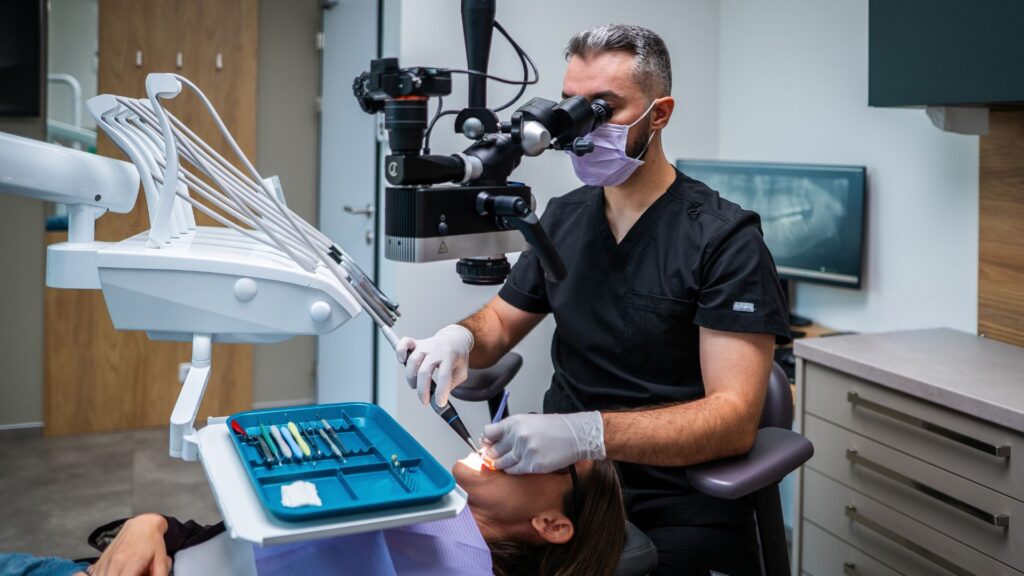
An apicoectomy, or root-end surgery, aims to preserve a tooth when conventional root canal treatment has failed or is no longer possible. The procedure removes the root tip and treats the surrounding area. The alternative is often extraction and replacement, so the decision is about which approach makes more sense for the individual tooth.
Conventional and microsurgical surgery have different outcomes. A success rate alone cannot determine the prognosis. The dentist must also consider the 3D scan, the root and surrounding bone, and whether the tooth can be restored to function reliably.
What do the figures show?
A meta-analysis in the Journal of Endodontics (Setzer et al., 2010) compared surgical endodontic outcomes by technique:
- Conventional root-end surgery: a success rate of 59%.
- Microsurgical treatment under an operating microscope: a success rate of 94%.
The difference is 35 percentage points in favour of microscope-assisted microsurgery.
These figures apply to root-end surgery, not conventional root canal treatment, whose success rate ranges from 86% to 93%.
Why do the results differ?
The microsurgical approach differs from conventional surgery in several important respects:
A small working area. The root tip is only millimetres wide and its canal measures fractions of a millimetre. Magnification reveals structures invisible to the naked eye.
Less bone removal. A smaller access window preserves more surrounding tissue.
More precise root-tip treatment. Fine ultrasonic instruments prepare the filling space under direct visual control.
Inspection. Magnification allows the prepared root tip and seal to be checked during surgery.
Modern equipment cannot guarantee success. The tooth’s initial condition and correct indication are equally important.
What else affects the outcome?
The technique is not the only factor. The prognosis of the tooth is also influenced by:
- Original treatment quality. An uncleaned or unfilled area may remain a bacterial source that surgery alone does not remove.
- Tooth position. Front teeth and upper premolars are usually easier to access than back molars.
- The root-tip lesion. Its extent can affect healing.
- Surrounding bone. Adequate support improves the long-term prognosis.
- Smoking. It can slow healing.
- Oral hygiene. Good hygiene supports healing.
For an older or unsuccessful root canal filling, root canal retreatment may be the better first step. Surgery may be considered when access through the crown is impossible or inappropriate. The retreatment article explains both approaches.
How should these figures be understood when making a decision?
A 94% success rate cannot automatically be applied to one tooth. Diagnosis, the root and bone, previous treatment and restorability all affect the outcome.
Apicoectomy is chosen when examination suggests that preserving the tooth is worthwhile. If it does not heal, extraction and replacement may still be needed.
If the root is cracked, support is severely damaged or the tooth cannot be restored, another approach may be preferable. The dentist therefore assesses the whole tooth, using a 3D scan if needed.
Apicoectomy forms part of endodontics. A microscope improves precision, while a 3D scan assists planning.
Frequently asked questions
What is the success rate of apicoectomy?
In the meta-analysis cited above, the success rate was approximately 59% for conventional root-end surgery and approximately 94% for the microsurgical approach under an operating microscope. Results vary between studies and individual patients.
Do these figures also apply to conventional root canal treatment?
No. They relate to surgical endodontics, meaning root-end surgery. Conventional root canal treatment has different success rates and cannot be compared directly with these results.
Why is root-end surgery performed under a microscope?
The dentist works in an area measuring only a few millimetres. Magnification allows more precise work, less bone removal and inspection of the treated root tip. The microscope itself, however, cannot guarantee the success of the procedure.
When is root-end surgery preferable to root canal retreatment?
If the canal can be accessed safely through the crown of the tooth, root canal retreatment may be a suitable option. Root-end surgery may be considered when the canal is blocked, access is particularly difficult or a lesion at the root tip persists despite correctly performed root canal treatment.
Conclusion
Apicoectomy can help preserve a tooth when conventional root canal treatment has not been sufficient or is not possible. Available data show better outcomes for microsurgical treatment than for conventional techniques, but these figures cannot be transferred automatically to an individual case. Whether the procedure is appropriate depends primarily on the condition of the tooth, root and surrounding tissues, and on whether the tooth can remain functional in the long term.
Are you considering an apicoectomy and would like to know the prognosis of your tooth? Book a consultation at m2stoma in Brno. Based on the examination and a 3D scan, we will assess the extent of the lesion, the condition of the surrounding tissues and the suitability of each treatment option.