

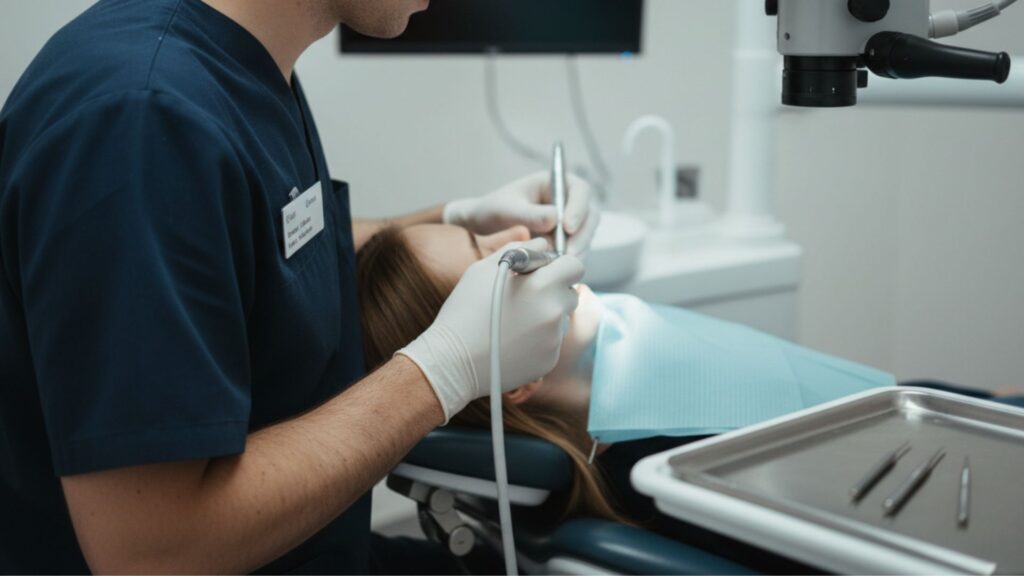
Your tooth is hurting in exactly the place where it was treated six years ago, and you find yourself back in the dental chair. Most people think in that moment that something was done wrong all those years back. The truth is usually different.
Primary endodontics has a high success rate — 86 to 93 % of cases heal and remain trouble-free for years. In the remaining cases, the treatment fails even when the dentist did the work without error. The reason is sometimes not in the dentist’s hands but in the biology of the tooth: a hidden accessory canal, bacteria that have survived in the dentinal tubules, or a leaky restoration that has let saliva back inside.
And that is exactly what retreatment is about — repeating the root canal treatment, which saves 70 to 85 % of such teeth. Let us take a look at when it makes sense, how it works and when it is, on the contrary, more sensible to part with the tooth.
What Retreatment Is and Why It Is Carried Out
Retreatment is the repeated root canal treatment of a tooth in which the primary endodontics has failed. The old root canal filling is removed, the canals are cleaned, disinfected and filled again with new material. The aim is to remove residual infection, heal the periapical inflammation and save the tooth without extraction.
Retreatment is typically called for in these situations:
- The patient feels pain, sensitivity to biting or swelling of the gum around a tooth that has had endodontic treatment.
- An X-ray or CBCT scan reveals persistent apical periodontitis (inflammation at the root tip) even in a tooth without symptoms.
- Before planned prosthetic work (a crown or bridge) on an endodontically treated tooth, where the quality of the existing filling is in doubt.
- When a new infection has entered the tooth because of a leaking restoration or a fractured crown.
Why the Primary Root Canal Treatment Failed
Endodontic failure is not a sign of negligence — it is often a biological or anatomical problem. The most common causes include:
- An undiagnosed accessory (lateral) canal. Vertucci, writing in Endodontic Topics (2005), described that upper molars have four canals instead of the standard three in up to 78 % of cases — and the fourth canal is easily overlooked without a microscope.
- Surviving bacteria. The species Enterococcus faecalis can survive in the dentinal tubules despite disinfection and cause secondary infection years later.
- A micro-fracture of the root discovered only after years.
- A defective crown restoration — even the best-treated canal will fail if saliva and bacteria re-enter the tooth through a poorly made restoration.
- Complex anatomy — curved canals, calcifications, accessory canals.
How Retreatment Works Step by Step
Retreatment is technically more demanding than primary treatment. At m2stoma we proceed as follows:
- Diagnosis including CBCT. A 3D scan reveals hidden canals, periapical lesions and micro-fractures that a panoramic X-ray will not catch.
- Local anaesthesia and isolation of the tooth with a rubber dam.
- Removal of the old root canal filling.
- Visualisation under the microscope. A dental operating microscope magnifies the field of view 6× to 25× — without it many lateral canals are not found.
- Reinstrumentation of the canals. Rotary instruments shape the canal into the ideal form for the definitive filling.
- Disinfection.
- Interim medication. In inflammatory cases, the canal is filled for 2–4 weeks with calcium hydroxide, which completes the disinfection.
- Definitive filling.
- Post-endodontic restoration. Without a quality build-up and crown, retreatment will fail within a few years. Endodontic treatment and the prosthetic work are one package, not two separate decisions.
The whole retreatment usually takes 60 to 150 minutes and is sometimes split across two visits — the first session for disinfection, the second for the definitive filling after 2–4 weeks.
The Success Rate of Retreatment and When It Makes Sense
The Toronto Study (Friedman & Mor, Journal of Endodontics 2004) — the largest prospective study of retreatment — shows a 70 to 85 % success rate after four years. This means that in 4 out of 5 patients, retreatment saves the tooth and the inflammation heals.
Factors that improve the prognosis:
- A small periapical lesion (up to 5 mm)
- No root fracture
- A planned, quality post-endodontic restoration of the tooth
- The use of a microscope during the procedure
When retreatment does not make sense and extraction is the better option:
- Vertical fracture of the root
- The root is extremely shortened by previous procedures
- There is not enough sound tooth structure for restoration
- The patient is unwilling or unable to invest in the subsequent prosthetic work
Frequently Asked Questions
Does retreatment hurt?
The procedure itself is carried out under local anaesthetic and is painless. After the procedure, you may feel sensitivity and pressure for 2–5 days, which settles with ordinary painkillers.
How many times can retreatment be repeated?
In practice, typically once. A second retreatment has a significantly lower success rate and is generally not recommended — the alternative is apicoectomy (a surgical procedure) or extraction.
When is it better to extract the tooth and have an implant?
When retreatment has a prognosis below 50 % on CBCT and clinical examination, when the tooth is non-restorable, or when it is vertically fractured. In that case, an implant is a better investment than retreatment that is condemned to fail.
Conclusion
Retreatment saves seven out of every ten teeth in which the primary endodontic treatment has failed. And one’s own tooth — even one that has been treated repeatedly — is almost always biologically more advantageous than an implant, which loads the bone differently and requires an entirely new recall logic.
Is a tooth that has already had root canal treatment hurting you? Do not wait until swelling or fever sets in. Arrange a consultation with microscopic diagnosis — we will assess the prognosis and honestly tell you whether retreatment makes sense, or whether it is more sensible to move directly to another solution.