

Were you told at your consultation that you do not have enough bone for a dental implant? There is no need to worry. In most cases, this is no longer an obstacle.
Modern implantology offers proven methods that can rebuild bone or create sufficient space for an implant to be placed safely. The most common of these are the sinus lift and bone augmentation. In this article, you will find out when these procedures are needed, how they are carried out and what you can expect from them.
When Does Bone Need to Be Rebuilt?
A shortage of bone most commonly occurs in the back of the upper jaw, in the molar region. If a tooth has been missing there for some time, the bone gradually resorbs while the maxillary sinus expands. The result is less bone into which an implant could be safely anchored.
Placing an implant generally requires sufficient bone height as well as width. Where there is not enough, it can be rebuilt through augmentation, or the floor of the maxillary sinus can be raised in a procedure known as a sinus lift.
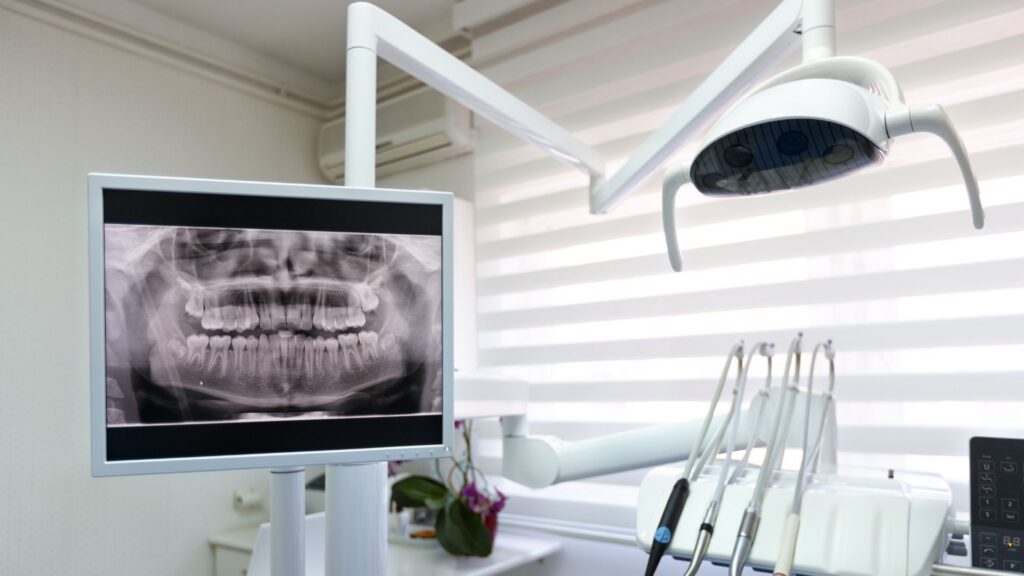
Before every implant placement in this region at m2stoma Brno, we carry out a CBCT scan. This three-dimensional image shows precisely how much bone is available as well as the anatomy of the maxillary sinus, which allows the entire procedure to be planned safely.
What Is the Difference Between Augmentation and a Sinus Lift?
Both procedures share the same goal: to provide enough bone for an implant to be placed. Where they differ is in the site at which they are performed.
Bone augmentation means rebuilding bone tissue in a place where there is not enough of it. It can be carried out practically anywhere in the mouth, for example after a tooth extraction or if your dental arch is too narrow.
A sinus lift is a specific type of augmentation used exclusively in the back of the upper jaw. During the procedure, the membrane lining the maxillary sinus is gently lifted and the space created is filled with bone material.
The materials most commonly used to rebuild bone are:
- bone material of animal origin (xenograft),
- synthetic bone substitutes,
- the patient’s own bone (autogenous bone).
Each material has its advantages, and which one is appropriate depends on the individual situation.
Closed or Open Sinus Lift?
There are two basic methods, differing in how extensive the procedure is.
Closed Sinus Lift
This is carried out through the opening prepared for the implant. It is suitable when only a few millimetres of bone need to be added. In most cases, the implant can be placed during the same procedure.
Open Sinus Lift
This is used where bone loss is more significant. The surgeon creates a small window in the lateral wall of the jaw, lifts the membrane lining the maxillary sinus and fills the space with bone material. If there is very little bone, the implant is placed only once the new bone tissue has healed.
The choice of approach is determined primarily by the amount of remaining bone and the results of the CBCT scan.
When Is the Implant Itself Placed?
There are two options.
If the existing bone is sufficiently stable, the implant can be placed at the same time as the sinus lift. Healing then takes approximately four to six months.
If there is very little bone, it is rebuilt first. The new bone usually heals over six to nine months, and only then is the implant placed. The overall treatment may therefore take approximately nine to fifteen months.
Both approaches have a high success rate, and the choice always depends on the individual findings.
Does a Sinus Lift Hurt?
The procedure is performed on an outpatient basis under local anaesthesia, so you will not feel any pain during treatment. Once the anaesthesia wears off, mild swelling or a sensation of pressure in the cheek area may occur. These effects usually subside within a few days.
It is important to follow your dentist’s instructions after the procedure. In the first few days, for example, you should avoid blowing your nose, intensive exercise and anything that creates increased pressure in the sinuses. In most cases, patients return to their normal routine within a few days.
How Much Do a Sinus Lift and Augmentation Cost?
The cost depends on the extent of the procedure, the method used and the amount of bone material required.
Bone augmentation at m2stoma Brno starts at 18,208 CZK (approx. €740). The exact cost of a sinus lift can only be determined following a clinical examination and CBCT diagnosis, as every case is different.
The treatment plan usually covers the surgical procedure, the bone material, a protective membrane, follow-up examinations and aftercare.
Frequently Asked Questions
How long does the procedure itself take?
A closed sinus lift usually takes approximately 60 minutes. The open method takes around 90 to 120 minutes, depending on how extensive the procedure is.
What is bone augmentation?
It is the surgical rebuilding of bone tissue in a place where there is not enough bone for an implant to be placed safely. The aim is to create a solid foundation for its long-term stability.
How long does bone take to heal?
Smaller augmentations usually heal over four to six months. With more extensive procedures or an open sinus lift, healing may take six to nine months. We always monitor the course of treatment through regular examinations.
Conclusion
In most cases, a shortage of bone no longer means you have to give up on an implant. Thanks to modern bone regeneration methods, even patients with significant bone loss can be treated successfully.
Successful treatment rests on careful planning using CBCT, the right choice of method and an experienced implantologist. If you are considering a dental implant, book a consultation at m2stoma Brno. Based on a detailed examination, we will prepare a treatment plan built around your individual situation.