

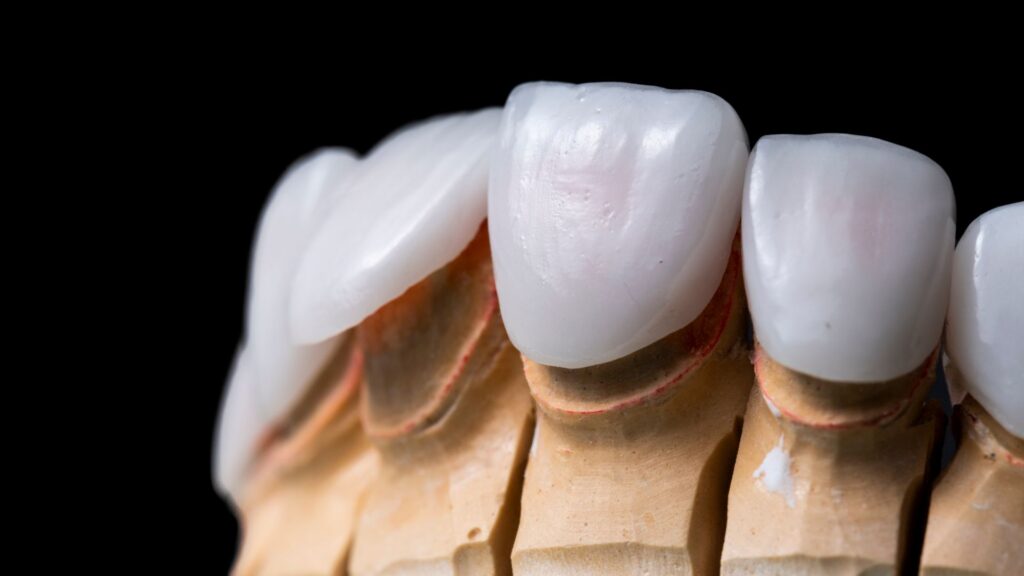
A Hollywood smile, perfectly straight teeth and a bright white set of teeth. Many of the smiles you see on social media or in magazines are not the work of nature, but of modern aesthetic dentistry. Dental veneers are one of the most common solutions behind them.
Veneers are thin ceramic or composite shells bonded to the front surface of the teeth, capable of adjusting their colour, shape and minor irregularities. They are not suitable for everyone, however. When do they genuinely make sense, and when is it better to choose something else?
What Are Dental Veneers?
A dental veneer is a very thin shell, approximately 0.3 to 0.7 mm thick, which is bonded to the front surface of the tooth. Its purpose is not to strengthen the tooth, but to improve its appearance.
Two types of veneer are most commonly used.
Ceramic veneers are made individually in a dental laboratory based on digital impressions. They are most often produced from porcelain or lithium disilicate ceramic. They stand out for their natural appearance, colour stability and long lifespan.
Composite veneers are shaped directly in the dental clinic from the same material used for white dental fillings. They are more affordable and quicker to place, although they usually do not last as long as ceramic veneers.
When Do Veneers Make Sense?
Veneers are not a universal answer to every aesthetic concern. They deliver the best results in patients who have healthy teeth and want to improve their appearance.
They are most commonly used for:
- pronounced tooth discolouration that cannot be removed by teeth whitening (for example following tetracycline treatment, in cases of fluorosis, or after a tooth has died),
- reshaping short or irregularly shaped teeth,
- closing smaller gaps between the teeth,
- minor wear or damage to the enamel,
- fine cracks in the enamel,
- slight irregularities in tooth position, where the patient does not wish to undergo orthodontic treatment.
It is important to stress, however, that veneers are not a treatment for tooth decay or any other disease. If a patient has active decay, gingivitis, periodontitis or grinds their teeth, these problems must be resolved first.
When Are Veneers Not Suitable?
Knowing when veneers will help is only half the picture. Knowing when a different solution is preferable matters just as much.
Veneers are generally not recommended in cases of:
- active tooth decay or untreated periodontitis,
- untreated bruxism, which significantly increases the risk of the veneers cracking or debonding,
- very thin enamel, where it is not possible to create a sufficiently strong bond with the tooth,
- extensive damage to the dental crown, where a dental crown is usually the more appropriate option,
- unrealistic patient expectations, as veneers do not change the position of the jaws and are no substitute for orthodontic treatment,
- childhood and adolescence, when the teeth are still developing.
How Long Do Veneers Last?
The lifespan of veneers depends primarily on the material used, the quality of the work and proper aftercare.
Ceramic veneers have a success rate of approximately 95 % after ten years. With good oral hygiene and regular check-ups, they can serve well for 15 to 25 years.
Composite veneers usually last 5 to 10 years. Their advantages are that they are simpler to repair and less expensive to place.
How Are Veneers Made at m2stoma Brno?
Creating veneers is a carefully planned process that usually involves several stages.
An initial consultation and a comprehensive examination of the teeth, gums and bite.
A digital design of your new smile (Digital Smile Design), which allows you to picture the outcome before treatment even begins.
The creation of a mock-up, a temporary model of your future smile.
Minimally invasive preparation of the teeth, where necessary. The aim is to preserve as much healthy enamel as possible.
Digital impressions and the production of the ceramic veneers in a dental laboratory.
Precise bonding of the veneers using modern adhesive materials.
A follow-up appointment and a schedule of regular preventive check-ups.
With composite veneers, the whole process is simpler and usually takes just one or two appointments.
How Much Do Dental Veneers Cost?
The cost depends on the material chosen, the number of teeth being treated and the complexity of the individual case. An exact quotation can only be provided following an initial consultation.
Frequently Asked Questions
Does preparing the teeth for veneers hurt?
In most cases the preparation is very gentle and local anaesthesia is not even required. If a larger amount of tissue needs to be removed, the procedure can readily be carried out under anaesthesia.
Can veneers come off while eating?
When properly bonded and used normally, the risk is minimal. The likelihood of damage increases mainly with teeth grinding, chewing ice, or using the teeth as a tool, for example to open packaging.
Can veneers be removed later on?
That depends on the type of veneer. With minimally invasive or so-called no-prep veneers, removal is usually possible with minimal impact on the tooth. If the tooth had to be prepared more extensively, however, a new veneer or a dental crown is normally required once the veneer is taken off.
Conclusion
Dental veneers are among the most effective methods in aesthetic dentistry, provided they are correctly indicated and properly made. They can significantly improve the appearance of a smile without the need for extensive work on the teeth.
If you are considering veneers, book a consultation at m2stoma Brno. Following a thorough examination, we will select the solution best suited to your smile together, whether that is ceramic veneers, teeth whitening, orthodontic treatment or another form of aesthetic restoration.