

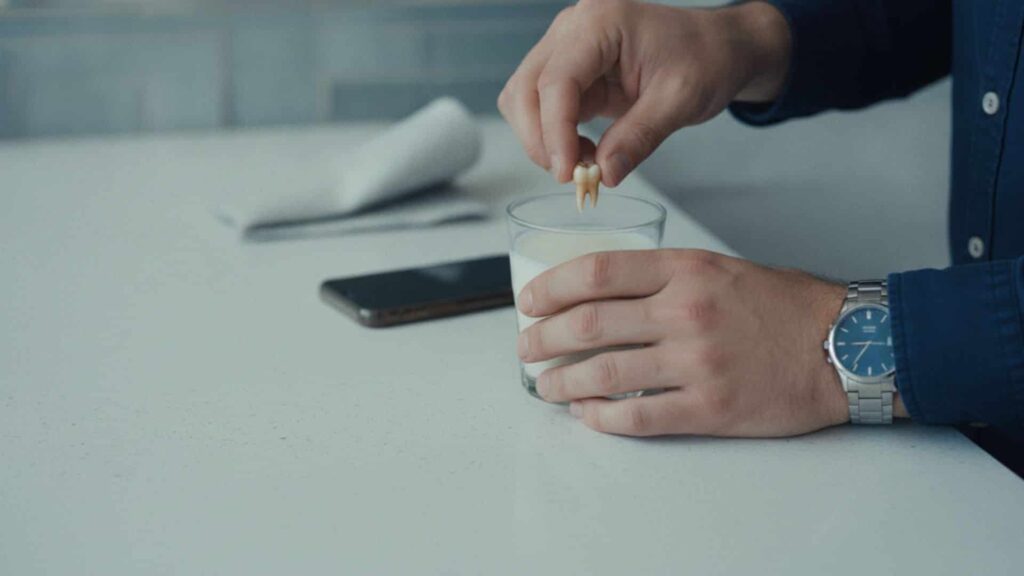
If you are reading this article with a knocked-out tooth in your hand, don’t read for long. You have 30 to 60 minutes to save the tooth. Here is the action plan.
STOP – Emergency Steps in 60 Seconds
A knocked-out tooth is an emergency in which time is decisive. The chances of successful replantation (reattaching the tooth) drop with every minute that passes — the rule is simple: the sooner, the better.
- Stay calm. Most cases are manageable.
- Find the tooth. Hold it ONLY by the crown (the white part), never by the root.
- Rinse the tooth under a stream of cold water if it is visibly dirty. Do not scrub, do not wipe.
- Store the tooth:
-
- Best: put it back into the tooth socket (only for adults with permanent teeth).
- Second best: in milk — cold, pasteurised.
- Third: under the tongue — only for an older patient.
- NEVER: in water, in paper, or dry in a pocket.
- Get to a dentist within 30–60 minutes. Call on the way so they are expecting you.
Knocked-Out Tooth vs. Chipped Tooth
Knocked-out tooth — the tooth has come fully out of the socket. It requires replantation within 60 minutes. Success rates:
- Replantation within 5 minutes: 90 % success
- Replantation within 30 minutes: 70–80 % success
- After 60 minutes: 30–50 % success
- After 2 hours: minimal chance
Chipped tooth — the tooth remains in the socket, but a piece of the crown, the enamel, the dentin, or the root has broken off.
- Grade 1 (enamel only): cosmetic; treat within 1 week.
- Grade 2 (enamel + dentin): sensitivity to cold. Visit within 24–48 hours.
- Grade 3 (enamel + dentin + pulp): bleeding at the fracture site, urgent — within 24 hours.
- Grade 4 (root fracture): clinical examination and an X-ray are essential.
Detailed Procedure for a Knocked-Out Tooth
1. Find the tooth.
2. Hold it by the crown, NOT by the root. The root surface carries sensitive periodontal ligament cells. If you squeeze them between your fingers or wipe them with a cloth, you destroy these cells — and replantation will fail even if the dentist performs the procedure perfectly.
3. Rinse for 10 seconds under running water. Only if the tooth is visibly dirty. Do not scrub, do not wipe, do not use soap.
4. Replant at home — if possible. Put the tooth back into the socket in its original position. Press gently and bite down on a piece of sterile gauze. Home replantation is only suitable for adults with permanent teeth. In children under 7, where the tooth is often still a primary (baby) tooth, do not replant.
5. If replantation is not possible, store the tooth in the correct medium:
- Milk — ideally cold and pasteurised; keeps the cells viable for up to 6 hours.
- Saline solution — available from a pharmacy, comparable to milk.
- Saliva — under the tongue of an older patient. Not for a child (risk of swallowing).
- NEVER water — osmotic shock destroys the cells within minutes.
- NEVER dry paper, a tissue, a pocket, or foil — the cells dry out in a few minutes.
6. Get to a dentist within 30–60 minutes. Call on the way. An emergency patient takes priority over scheduled appointments.
Detailed Procedure for a Chipped Tooth
Find the broken-off fragment if you can.
Store the fragment in milk or saline solution. The dentist may be able to bond it back onto the remaining tooth — the result is both aesthetic and functional.
If there is bleeding (an exposed pulp) — apply sterile gauze with gentle pressure for 5 minutes.
Pain relief — ibuprofen 400 mg as needed.
A cold compress on the outside of the cheek — reduces swelling.
See a dentist within 24 hours.
For minor enamel-only chips, a follow-up within 1 week is sufficient.
Special Situations
Primary (Baby) Tooth Knocked Out in a Child
Do NOT put a primary tooth back into the gum. The developing permanent tooth lies in the jaw directly beneath it — replantation could damage it.
- Gum bleeding: gauze with gentle pressure for 5 minutes.
- Pain: children’s paracetamol or ibuprofen at the recommended weight-based dose.
- Dental check-up within 24 hours — to rule out damage to the permanent tooth bud.
- Follow-up in 6 months — to monitor the development of the permanent tooth.
Tooth Knocked Out During Sport
Ice hockey, rugby, football, MMA, horse riding — sports with a high risk of dental trauma. Keep the following in your first aid kit:
- Sterile gauze
- A small bottle of pasteurised milk (or saline solution)
- Ibuprofen 400 mg
- The contact details of an oral surgeon
Knocked-Out Tooth in an Older Patient
Replantation has a lower success rate with age — the periodontal ligament cells become more vulnerable. For patients over 60, we often plan a dental implant directly, provided the gum and bone are in good condition.
What NOT to Do
- Do not scrub the tooth with a brush or clean it with soap.
- Do not store the tooth in water — osmotic shock destroys the periodontal cells.
- Do not store it in a tissue, paper, or dry in a pocket — the cells dry out.
- Do not wait for hours — every minute reduces the chance of replantation.
- Do not try to pull out a fractured root fragment yourself.
- Do not postpone the visit just because “the bleeding has stopped” — unpleasant complications can develop later.
Frequently Asked Questions
Can I replant a tooth that fell into mud on a sports field?
Yes. Rinse for 10 seconds under running water (DO NOT SCRUB), place it in milk, and head to the dentist. Even a slightly contaminated tooth is a better candidate for replantation than no tooth at all.
My child is 9 years old and lost a tooth — is it a baby tooth or a permanent one?
At 9, the front teeth are usually already permanent (they are typically replaced between the ages of 6 and 8). If you are unsure: a baby tooth has a shorter root and a smaller crown. If you are confident it is a permanent tooth, replant it. If you have any doubt, get to the dentist with the tooth stored in milk — a professional will decide.
What if the tooth falls out again after replantation?
This happens in 15–30 % of cases (typically due to root resorption). The alternative is a dental implant. Even so, replantation is worth the attempt.